
Q3 Quarterly Gas Pipeline Rates Update: Current Rate Cases, Comebacks and Moratoria
Originally published for customers September 2, 2026. What’s the issue? The five ongoing Section 4 rate cases are for relatively…

Originally published for customers Oct 28, 2026
What’s the issue?
Ohio is facing a new wave of data center-driven power demand, on the heels of a substantial historic shift from coal to natural gas generation.
Why does it matter?
This demand is prompting new investment proposals and could require significant new generation, transmission, and natural gas infrastructure, making its regulatory structure and political environment key for developers to understand.
What’s our view?
The scale and timing of development remain uncertain because concerns about electricity costs, speculative demand, and local impacts are creating commercial and political headwinds.
Ohio is facing a new wave of data center-driven power demand, on the heels of a substantial historic shift from coal to natural gas generation. This demand is prompting new investment proposals and could require significant new generation, transmission, and natural gas infrastructure, making its regulatory structure and political environment key for developers to understand. The scale and timing of development remain uncertain because concerns about electricity costs, speculative demand, and local impacts are creating commercial and political headwinds.
Nobody knows the future, but Ohio’s electricity demand could more than double over the next two decades, according to the Public Utilities Commission of Ohio’s (PUCO) September 2026 Long-Term Forecast of Energy Requirements.
PUCO projects that Ohio’s peak electricity demand will increase 81.1% between 2024 and 2044, driven primarily by anticipated data centers. Annual electricity consumption is projected to rise from 153.9 million MWh to 321.5 million MWh, an increase of approximately 109%.
PUCO developed two scenarios:
1) Base case: reflects historical trends like its continued shift from coal to natural gas and expected organic growth, including relatively little new data center development.
2) High-growth: incorporates large-load additions reported by utilities in April 2026 (primarily data centers but also some manufacturing facilities).
The Base case projects annual electricity consumption of approximately 160.6 million MWh by 2044, barely above its 2024 level of 153.9 MWh. But with the large load additions in the high-growth scenario, consumption reaches 321.5 million MWh, nearly twice the base-case forecast. Most of that growth would arrive relatively soon, approaching 291 million MWh by 2030.
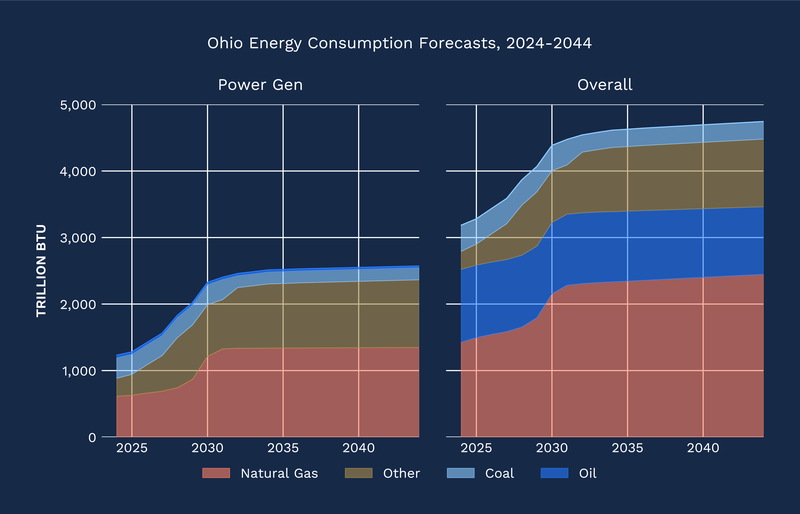
The effects ripple into generation sources. PUCO projects that total natural gas consumption will increase from 1,425.7 trillion Btu in 2024 to 2,446.0 trillion Btu in 2044 under high growth, a 72% increase. Natural gas requirements for electricity generation more than double, reaching 1,346.8 trillion Btu in 2044 and accounting for approximately 55% of the state’s projected gas requirements. Coal use, meanwhile, continues to decline under both scenarios, also contributing to increased natural gas use.
Ohio will need more natural gas pipeline capacity to meet the forecasted growth in natural gas demand. Below, we show Ohio’s major interstate natural gas pipeline footprint and proposed natural gas generation capacity additions by county.
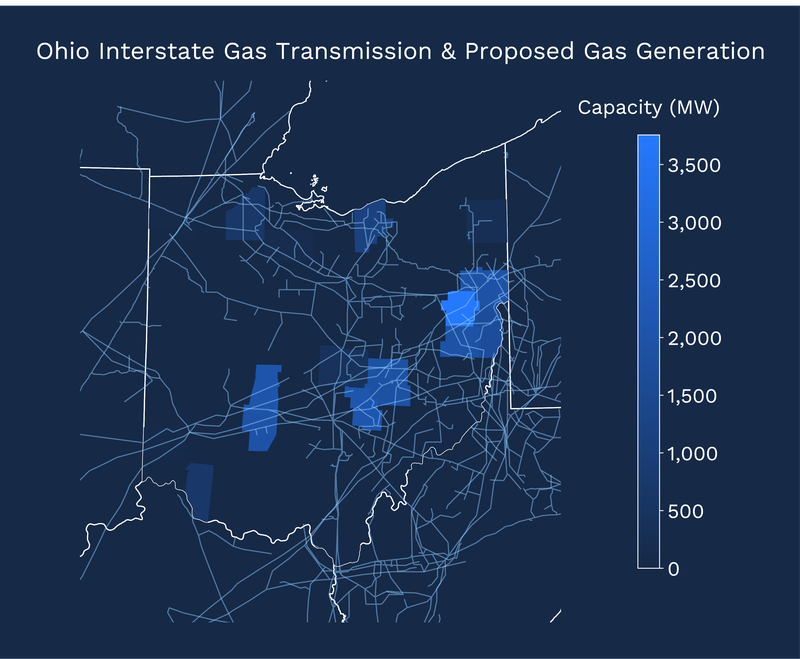
Three projects are pending at FERC that propose to increase capacity to serve natural gas/electric utilities in Ohio. These are: the Appalachian Reliability Project, Carnation Project, and Dearborn County Lateral Project. The Dearborn County Lateral Project will directly serve the new Miami Fort Power Plant in Hamilton County, Ohio. Four projects are in more preliminary stages: the Northwoods Project (pre-filed February of this year), Borealis Project (expected to pre-file this quarter or the next), POWER Project, and 219 South Project. Initially offering 530,000 Dekatherms per day of firm transportation service, the 219 South Project ended its open season with over 2 billion cubic feet per day of shipper interest. The POWER Project just ended its open season.
Back to where we started, projections are not commitments. PUCO’s high-growth scenario includes prospective large loads that have reached specified interconnection milestones, but whose development remains uncertain. Its fuel forecasts also incorporate assumptions about accelerated gas-fired generation development, among other adjustments. The question, as with any forecast, is how much of that anticipated growth will materialize and whether Ohio can accommodate it.
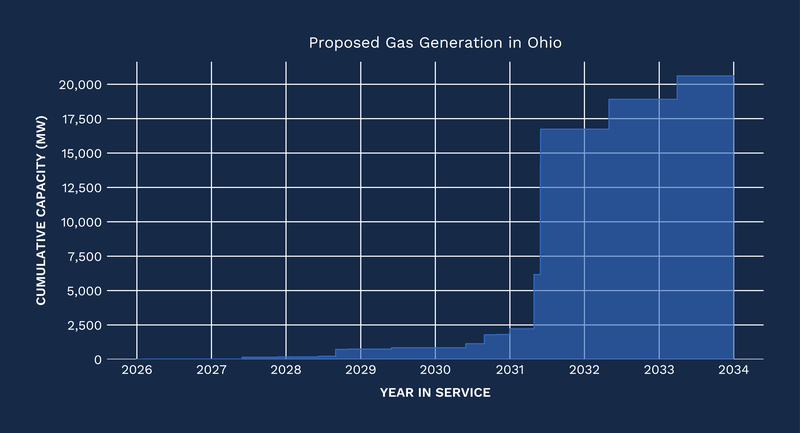
Right now, about 20,611 megawatts of natural gas generation capacity are pending interconnection in the PJM interconnection queue in Ohio.
Ohio is already one of the country’s leading data center markets, with major concentrations around Columbus and New Albany. But when OpenAI, Nvidia, Japanese investors, and the Department of Energy (DOE) team up you get something massive, the proposed 10 GW PORTS-Pike Technology Campus (PORTS) at a former federal uranium enrichment facility in southern Ohio, envisioned to include:
Development will occur in phases, with the first 800 MW expected in 2028, largely using existing infrastructure from AEP, a major Ohio utility. Subsequent phases depend on new generation, transmission, permitting, environmental reviews, and financing.
Meeting those requirements involves several parties with distinct responsibilities within Ohio’s competitive electricity market (unlike traditionally regulated markets, where utilities generally own power plants and recover the costs of generation through regulated rates, Ohio’s generators compete to supply electricity that utilities deliver). The major players include:
Utilities: Ohio’s major investor-owned electric utilities include AEP Ohio, FirstEnergy’s Ohio subsidiaries, AES Ohio, and Duke Energy Ohio. Each serves a defined geographic territory and plays a central role in connecting new customers to the grid.
PJM: operates the regional wholesale electricity market, administers generator interconnections, coordinates transmission planning, and oversees resource adequacy. Its load forecasts help determine future generating capacity and transmission requirements.
PUCO: in addition to creating fun forecasts, regulates electric utility service and tariffs, including measures intended to protect existing customers from data center infrastructure costs.
The Ohio Power Siting Board (OPSB): part of PUCO but oversees the siting of major power plants, transmission facilities, and certain natural gas pipelines.
PORTS proposes to address much of the regulatory friction through dedicated generation and transmission investment. Its developers have committed to covering project-specific energy and infrastructure costs rather than passing them to Ohio ratepayers. That arrangement could provide a model for accommodating extraordinary new loads while limiting exposure for existing customers.
Ohio’s data center boom is encountering two main forms of opposition:
Rising power bills loom large nationally, but Ohio has seen a 63% increase in residential electricity bills between September 2021 and September 2026, according to the Electricity Price Hub, nearly double the national average of 33.4%.
Opposition to the facilities themselves reflects familiar concerns about land use, emissions, and water consumption. But in Ohio, that opposition is increasingly reaching the ballot box. According to Ballotpedia, Ohio accounts for 21 of the 49 (43%) data center-related ballot measures it is tracking nationwide, more than any other state. Not all of these measures seek to restrict development, although several propose local restrictions scheduled for November. A separate statewide moratorium campaign is gathering signatures for a potential 2027 vote.
The issue has also reached Ohio’s gubernatorial race. Democratic nominee Amy Acton, Republican nominee Vivek Ramaswamy, and Libertarian Don Kissick all support pumping the brakes on data center development in some fashion, although their proposals differ.
This is why Ohio is interesting. It represents a supercharged microcosm of the major issues surrounding data center development: an already substantial buildout with enormous projected growth, the world’s largest proposal, electricity bills rising faster than the national average, more ballot measures than any other state, and gubernatorial candidates from all three parties proposing restrictions.
Browse recent blogs about a similar topic.
Originally published for customers September 2, 2026. What’s the issue? The five ongoing Section 4 rate cases are for relatively…

Planned pipeline projects could push U.S. interstate gas capacity to ~294 Bcf/d by 2029. Arbo breaks down the pace, drivers, and permitting risks.

Pipeline growth shifts toward more interstate pipe and compression, expanding in the Southeast and Midcon as Appalachia stays constrained.