
Ohio’s Data Center Boom: Peaking Power and Pushback
Ohio’s peak demand could rise 81% by 2044 as data centers drive new gas, pipeline and transmission needs, while rising bills and ballot measures fuel pushback.

Originally published for customers Oct 30, 2026
What’s the issue?
Kentucky faces substantial potential data center demand, but its electric utility structure is unusually complex.
Why does it matter?
Demand forecasting, infrastructure planning, and regulatory requirements vary considerably across utility territories.
What’s our view?
Kentucky’s new Energy Planning and Inventory Commission (EPIC) should improve statewide forecasting. Its recent reports also show the state learning from Ohio and Virginia by emphasizing developer financial commitments and ratepayer protections before infrastructure investments are made.
Kentucky faces substantial potential data center demand, but its electric utility structure is unusually complex. Demand forecasting, infrastructure planning, and regulatory requirements vary considerably across utility territories. Kentucky’s new Energy Planning and Inventory Commission (EPIC) should improve statewide forecasting. Its recent reports also show the state learning from Ohio and Virginia by emphasizing developer financial commitments and ratepayer protections before infrastructure investments are made.
Kentucky is coal country, although its electricity generation mix has changed considerably. According to the Energy Information Administration (EIA), coal supplied more than 90% of Kentucky’s electricity generation in 2014, but its share had fallen to 67% by 2024. Natural gas, meanwhile, grew from less than 3% to 26% over the same period.
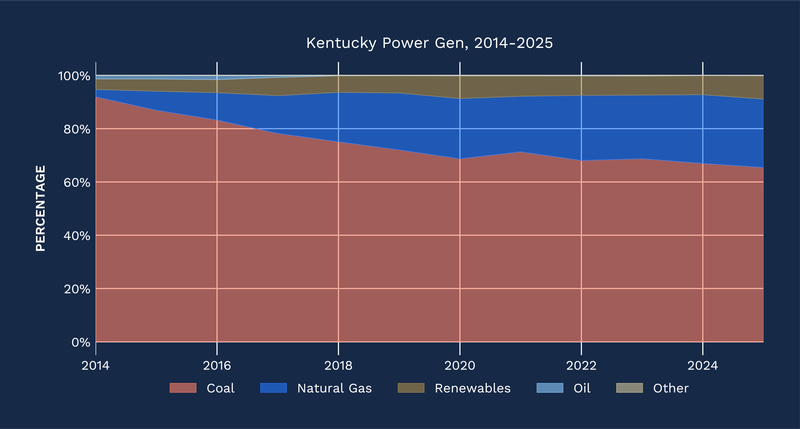
That shift has come with substantial coal retirements. Approximately 5,800 MW of coal-fired capacity shut down between 2014 and the beginning of 2025, leaving roughly 8,600 MW operating. Even after those closures, Kentucky remained among the five states with the most coal-fired generating capacity.
Two recent Kentucky bills (SB 4 and SB 349) also make it harder to retire existing fossil-fuel generation by:
Together, these requirements favor continued fossil-fuel generation and make retirements more difficult, expensive, and time-consuming. As Kentucky adds natural gas generation to meet growing demand, that capacity may supplement some of its existing coal fleet rather than simply replacing it.
See below for a map of Kentucky’s existing major interstate gas transmission infrastructure.
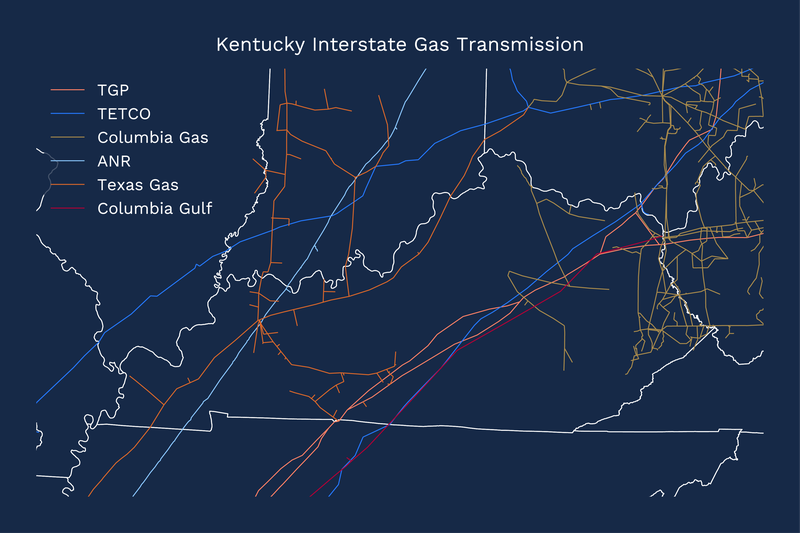
Four of the projects before FERC propose to boost energy supply for gas/electric utilities in Kentucky. These are the Maysville Project, Pulaski Project, Northwoods Project, and Clark Project.
Both the Maysville and Pulaski Projects belong to Columbia Gulf and demonstrate Kentucky’s investment in gas. The Maysville Project will help power electric utility East Kentucky Power Cooperative’s (EKPC) Hugh L. Spurlock Generating Station in Madison County, while the Pulaski Project will help power EKPC’s John Sherman Cooper Power Station in Pulaski County. Previously 100% coal-fired, these power plants will also run on gas after the Maysville and Pulaski Projects are completed. The Clark Project also belongs to Columbia Gulf. Like the Maysville and Pulaski Projects, it will serve EKPC, but it will help power EKPC’s gas-fired J.K. Smith Station in Clark County.
As discussed in Ohio’s Data Center Boom: Peaking Power and Pushback, the Northwoods Project is in pre-filing, and the 219 Project is moving forward, with a hugely successful open season behind it.
Kentucky’s electric utility structure is more complex than most states, making demand forecasting a bit of a chore. It has utilities participating in two regional transmission organizations (RTO) (PJM and MISO), one major utility operating outside either market, and five distribution cooperatives supplied by the Tennessee Valley Authority (TVA). Kentucky’s major electric utilities generally file Integrated Resource Plans (IRPs) with the Kentucky Public Service Commission (PSC) every three years that forecast electricity demand and evaluate needed resources, but each covers its own territory, with different assumptions about data center development.
EPIC, created in 2024, is working toward a statewide demand forecast, but for now, we need to look at individual utilities. Three are particularly interesting because of their size, market arrangements, and potential data center growth.
1) LG&E/KU: The Biggest Player
Louisville Gas and Electric (LG&E) and Kentucky Utilities (KU) is Kentucky’s largest investor-owned electric utility group. They are also the only major Kentucky utilities operating outside an RTO. Their 2024 IRP includes low-, mid-, and high-growth forecasts. Under the mid-growth scenario, annual electricity requirements rise from approximately 29,664 GWh to 41,204 GWh by 2032, including 1,050 MW of additional data center load.
EPIC’s June 2026 report adds that LG&E/KU had 29 prospective data center projects, including 11 representing approximately 3.5 GW that the utilities assigned at least a 50% probability of proceeding. Their parent company subsequently described total prospective demand of approximately 12 GW. It’s hard to know how much will actually materialize but it’s useful as a trend.
2) East Kentucky Power Cooperative: The Missing Data Centers
East Kentucky Power Cooperative’s (EKPC) IRP attracted attention from Sierra Club because it excludes prospective data center demand. During the PSC’s review, staff requested supplemental modeling of a hypothetical 1 GW data center operating at a 95% load factor. EKPC’s model selected two additional 745 MW natural gas combined-cycle units as the least-cost solution, totaling 1,490 MW of new generation. PSC staff recommended that EKPC account for potential data center loads in future forecasts.
That’s probably a good idea, because one of the largest proposed data centers in the state was recently revealed to be a META-backed campus in Mason County, covering almost 3000 acres and potentially requiring 2.2 GW.
3) Big Rivers: Small Utility, Big Ambitions
Big Rivers Electric Corporation serves three distribution cooperatives in western Kentucky and participates in MISO. It is considerably smaller than LG&E/KU or EKPC, but it is attracting significant data center interest. In its September 2026 IRP, Big Rivers reported receiving 31 requests for information from data center developers since the beginning of 2025, nearly as many as from every other industry combined. Only five projects had advanced beyond initial discussions, but two are among Kentucky’s most significant developments:
Kentucky rolled out the welcome mat for data centers with tax incentives in 2024, and some projects have attracted local support with new jobs and billions in investment, but not everyone is eager to have one next door. Opposition has reached the level of temporary data restrictions in some localities and at least one permanent prohibition in Woodford county. The concerns are familiar: land use, water consumption, environmental impacts, and whether the economic benefits are worth the cost to communities.
For that reason, the state’s approach reflects lessons learned from Ohio and Virginia, emphasizing financial commitments from data center developers and protections against shifting infrastructure costs to existing ratepayers before construction begins. Governor Andy Beshear also issued an ambitious executive order that requires developers to show they can meet demand without raising other customers’ costs and directs regulators to restrict projects.
Browse recent blogs about a similar topic.
Ohio’s peak demand could rise 81% by 2044 as data centers drive new gas, pipeline and transmission needs, while rising bills and ballot measures fuel pushback.

Originally published for customers September 2, 2026. What’s the issue? The five ongoing Section 4 rate cases are for relatively…

Planned pipeline projects could push U.S. interstate gas capacity to ~294 Bcf/d by 2029. Arbo breaks down the pace, drivers, and permitting risks.