
Picking up the Pace of the Pipeline Buildout
Planned pipeline projects could push U.S. interstate gas capacity to ~294 Bcf/d by 2029. Arbo breaks down the pace, drivers, and permitting risks.

Originally published for customers September 2, 2026.
What’s the issue?
The five ongoing Section 4 rate cases are for relatively small pipeline systems and seem to be relatively routine.
Why does it matter?
Regularly tracking these deadlines highlights which pipelines could be moving into higher-exposure windows, allowing stakeholders to stay ahead of potential rate changes.
What’s our view?
The expiration of moratoriums or comeback provisions for almost twenty pipelines should sustain steady rate case activity for the next 18 months.
In our Q2 Quarterly Rates Update: Form 2 Filings and Rate Case Exposure, we focused on the financial status of pipelines with upcoming rate case exposure based on reported 2025 operating revenue and calculated rate base. That review identified that most of the pipelines unprotected by moratoria (or soon to be unprotected at time of publishing) consisted primarily of smaller interstate operators.
Since that article was published, two pipelines have filed new Section 4 rate cases, three in-progress cases have effectively settled, and one pipeline is no longer protected by a moratorium.
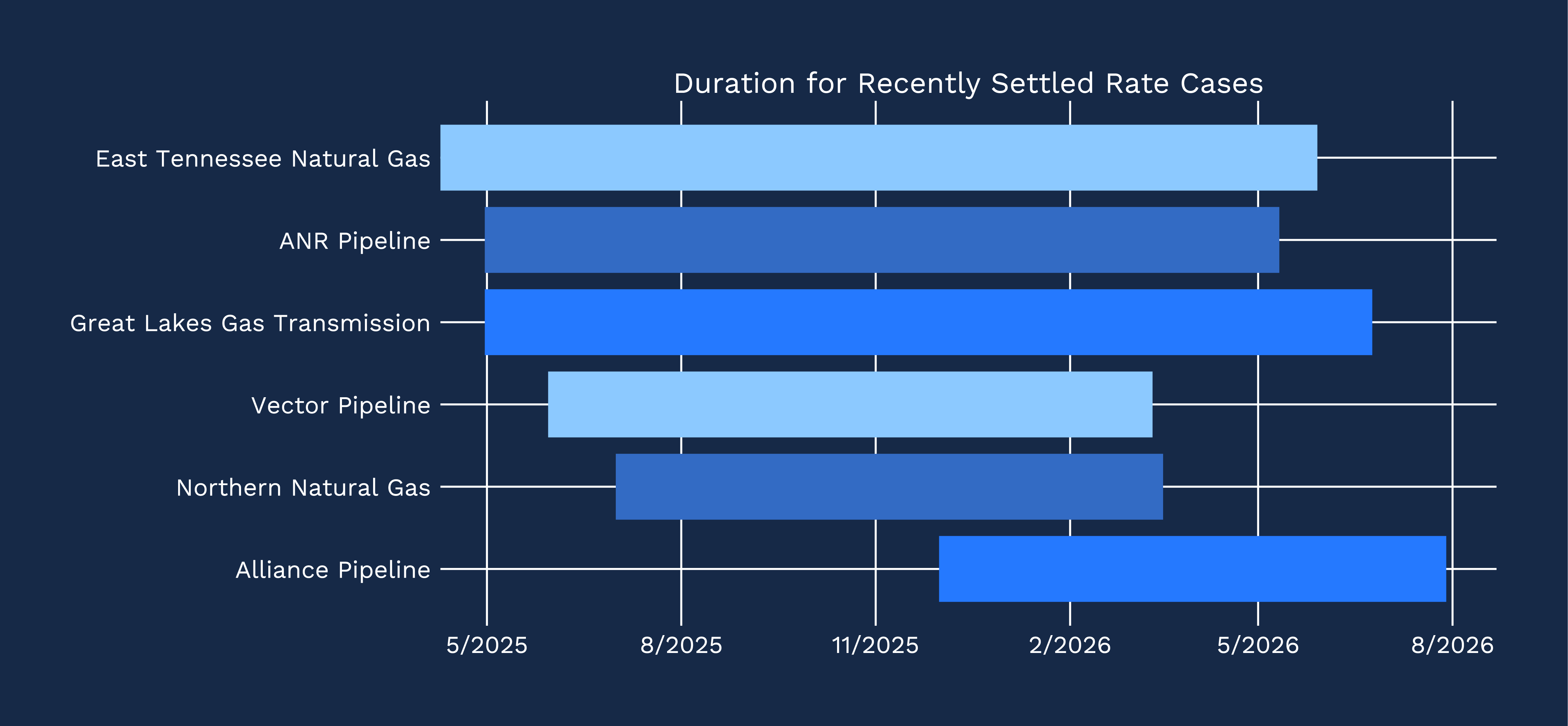
Since the beginning of 2026, six pipeline cases have essentially reached settlements with their shippers.
Northern Natural Gas reached a contested settlement in March. Remaining opposition was withdrawn by the end of June. As part of the case’s settlement, Northern Natural established a moratorium until July 2027 with no comeback date. However, Northern Natural has filed a Section 4 rate case on July 1 in each of the years 2019, 2022, and 2025, so we would expect a new Northern Natural rate case no later than summer 2028.
Alliance Pipeline has submitted an interim settlement filing and settlement procedures have been suspended, but the pipeline has yet to file a Stipulation Agreement, so the pipeline’s future moratorium and comeback dates are currently unknown.
The rest of the pipelines that have settled this year will be protected until Q3 2029 at the earliest, two of which will remain protected by a moratorium until late 2030.
There are currently five pipelines undergoing full Section 4 rate proceedings at FERC. Four of the five have filed rate cases since the end of April. Trailblazer is currently 10 months into its rate case. For comparison, the average time to settlement for our recently settled cases was 11 months. Trailblazer is a bit of an outlier, which we detailed in Q2 Quarterly Rates Update: Form 2 Filings and Rate Case Exposure, due primarily to significant system changes resulting in contracts for off-system capacity on Rockies Express and Tallgrass, significantly driving up the pipeline’s reported cost of service. Trailblazer is also the pipeline with the smallest reported rate base, clocking in at $121 million. The remaining four pipelines have reported rate bases close to or well over $1 billion.
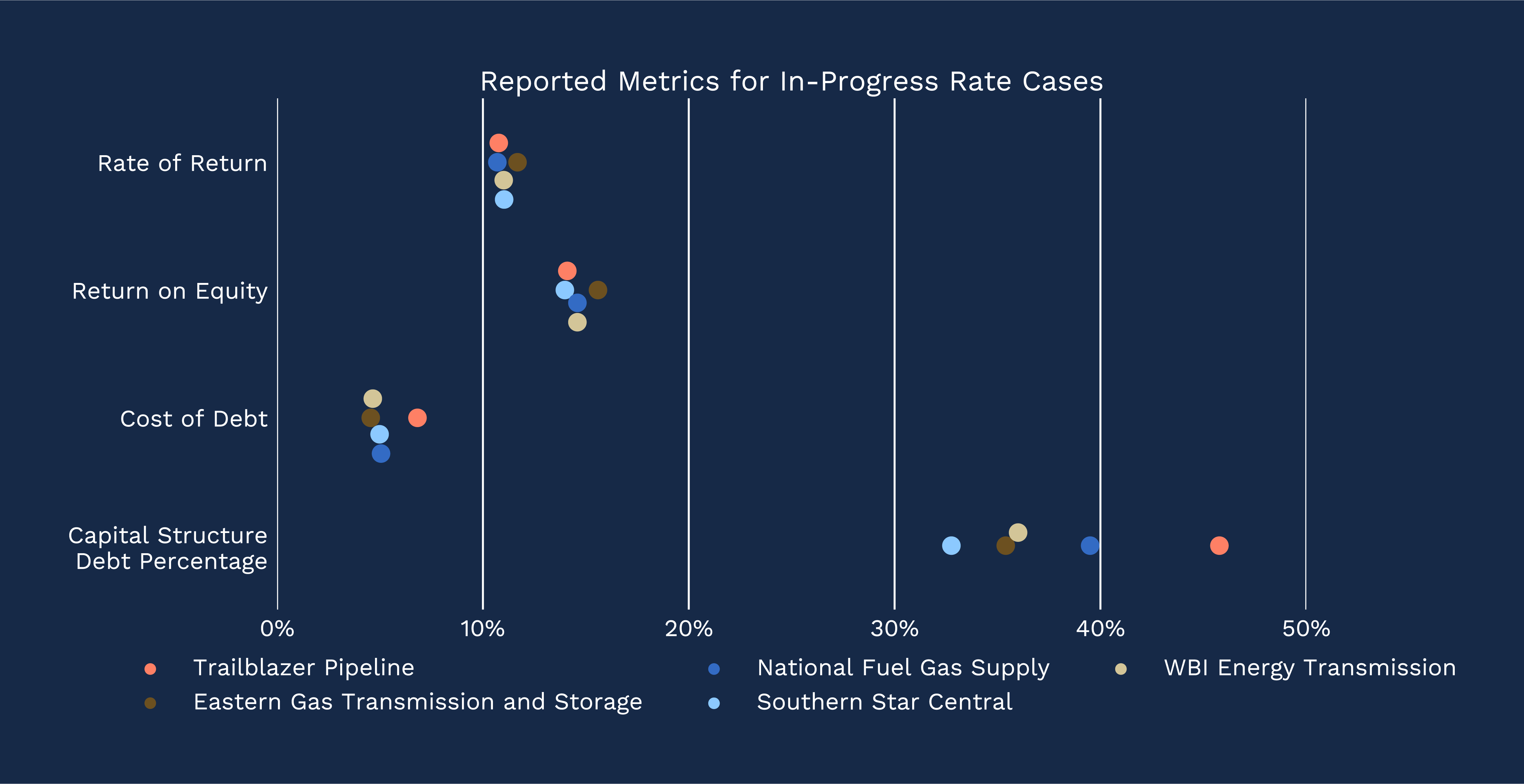
All five pipelines fall relatively in line with one another on requested rate of return, ranging from 10.7% to 11.68%. Eastern Gas Transmission and Storage stands out with the highest requested ROE at 15.59%. Trailblazer’s capital structure also diverges from the norm, with a debt percentage of 45.78% and equity percentage of 54.22%.
National Fuel and Southern Star seem to be pretty similarly situated in terms of their ongoing rate cases. Both reported a rate base of $1.4 billion and are requesting to introduce a modernization cost recovery mechanism as part of their rate case. National Fuel has a single rate zone and has requested a 54.2% increase in firm transportation rates. Southern Star has two rate zones, and requested a 96% increase in firm transportation rates for contracts in its Production Zone and a 42% increase in rates for contracts in the Market Zone. We’ll be following these two closely to see if these cases end up with similar outcomes.
WBI Energy Transmission has requested a relatively modest rate increase (as far as requested increases go) of 35.5% for firm transportation rates across the system. The rate case appears to be relatively routine so far, with the first settlement conference taking place at the end of July. Additional settlement conferences have been scheduled for October and December.
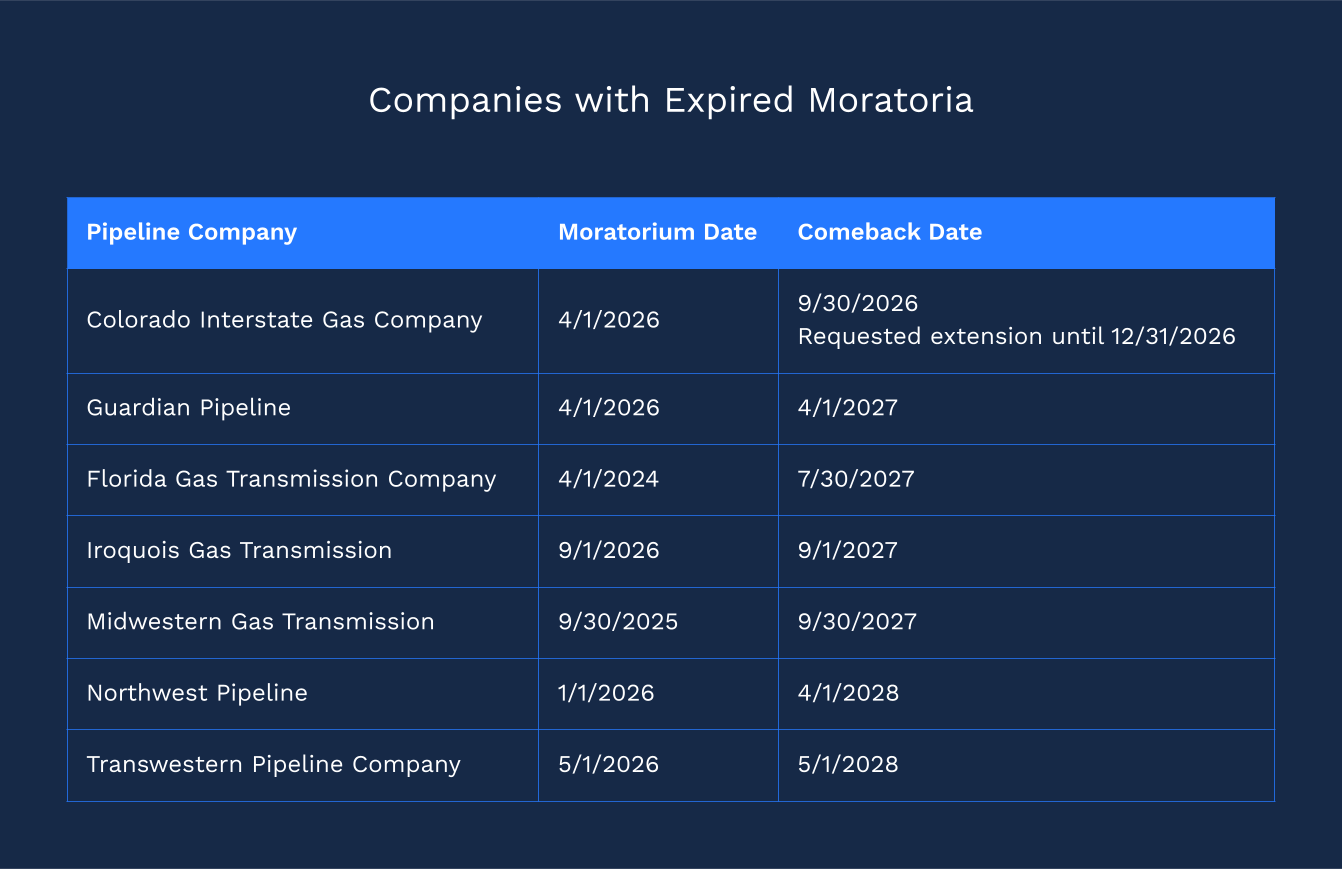
Colorado Interstate Gas’s comeback date is looming, but the pipe is in active discussions with its customers and has requested that FERC grant a three month extension to December 31, 2026, as participating parties “believe that additional discussions would be beneficial and worthwhile to attempt to consensually resolve issues and obviate the need for the filing of the required rate case.” Assuming FERC grants this request, the most likely outcome is that the pipeline settles rather than undergoing a full Section 4 rate case.
Four of the remaining seven unprotected pipelines must file a rate case by the end of September 2027 at the latest. However, given the nature of some of these systems, some may be able to settle in advance and avoid a full Section 4 proceeding like Colorado Interstate Gas is attempting to do.
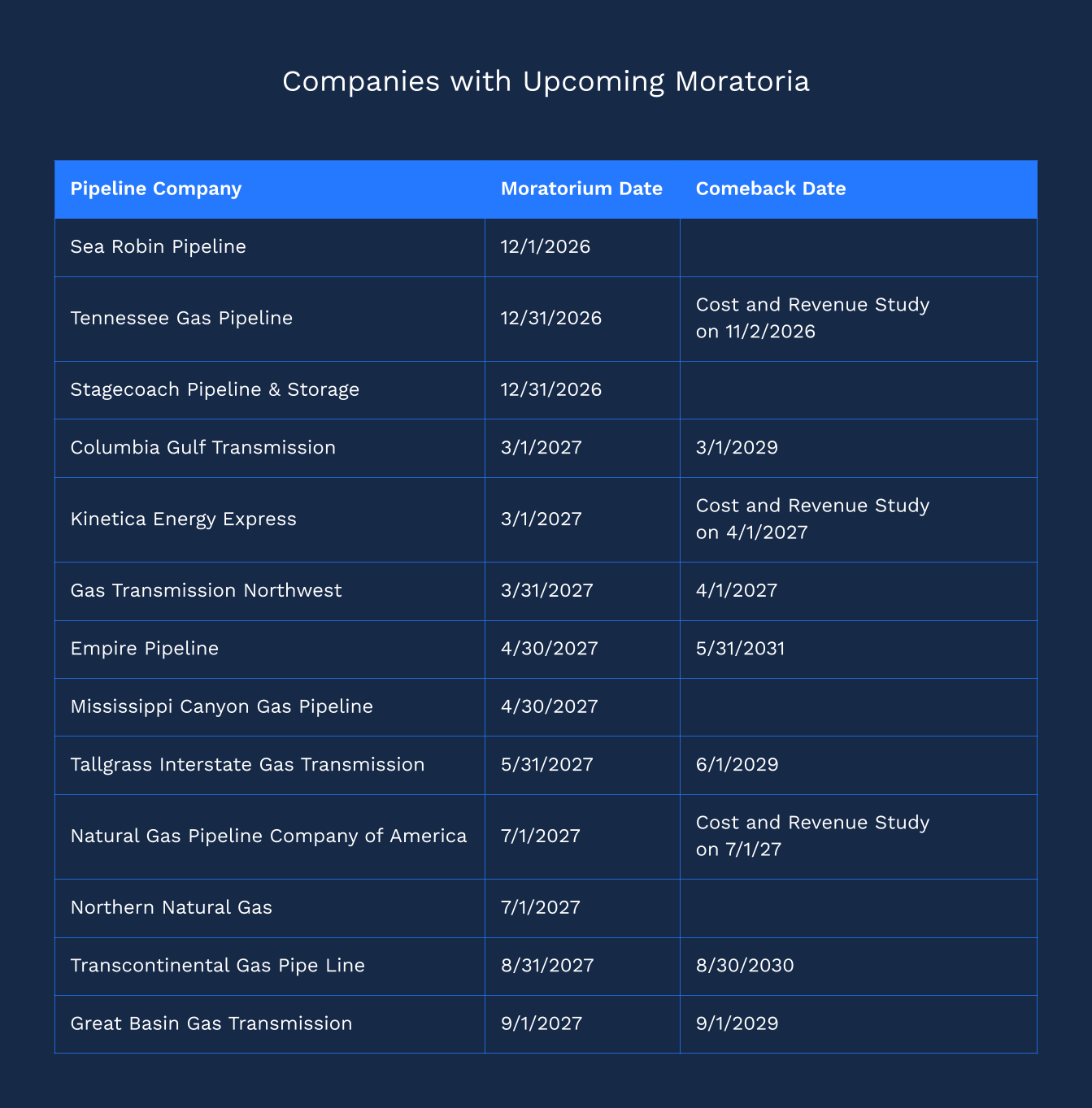
For the pipelines with moratoria dates in the next 12 months, none will become unprotected until December at the earliest. After that, there’s a significant number of potential rate cases: but a ton unprotected after that: 13 total by September 2027. However, Gas Transmission Northwest is the only one that must file a rate case in 2027. We’re also watching Tennessee Gas closely, as it is the largest by far in this group in terms of revenue, but also because this system hasn’t undergone a true Section 4 rate case since before 2019. As a result of its 2019 501G filing, the pipeline underwent a cumulative rate reduction of 8% from 2023.
Browse recent blogs about a similar topic.
Planned pipeline projects could push U.S. interstate gas capacity to ~294 Bcf/d by 2029. Arbo breaks down the pace, drivers, and permitting risks.

Pipeline growth shifts toward more interstate pipe and compression, expanding in the Southeast and Midcon as Appalachia stays constrained.

U.S. gas storage stayed flat as LNG exports surged. Arbo tracks Texas gas storage projects through Railroad Commission permits, not developer claims.